

Park · Manchester · ⭐ 9.1/10 · 4686 reviews · updated: 2026-08-04 20:23:00
Address: Fallowfield, Manchester M14 6LA, United Kingdom
Platt Fields Park — the 170 acres Manchester’s citizens fought to keep
South Manchester’s biggest green space was not a gift from a landowner. It was taken into public hands after a local campaign refused to let the fields be built over, and then it was dug out by hand, in the winter of 1908–09, by hundreds of men who had no other work. That is why Platt Fields feels different from a landscaped estate: the lake, the island, the terraces and the walks were made deliberately for a city that wanted them. A century later it is still doing exactly that job — a Georgian hall at one end, a market garden growing real food, a sunken Shakespearean garden, and on carnival and festival weekends one of the most genuinely mixed crowds in the north of England.
Highlights
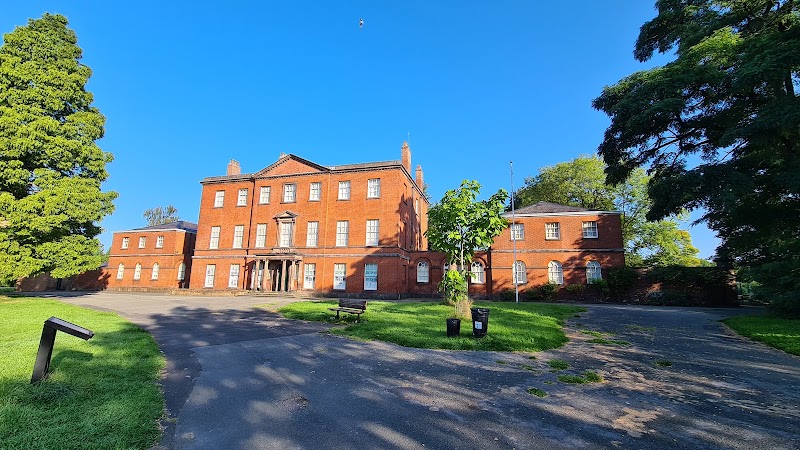
- Platt Hall — a Grade II* listed red-brick Georgian house built in 1746 at a cost of around £10,000 to designs by Carr of York, later modified by Timothy Lightoler, and now a community-focused cultural venue rather than a conventional museum.
- The boating lake and island — just over six acres of water and island created in the winter of 1908–09 by diverting the Gore Brook, dug by more than 700 men taken on during a period of severe unemployment.
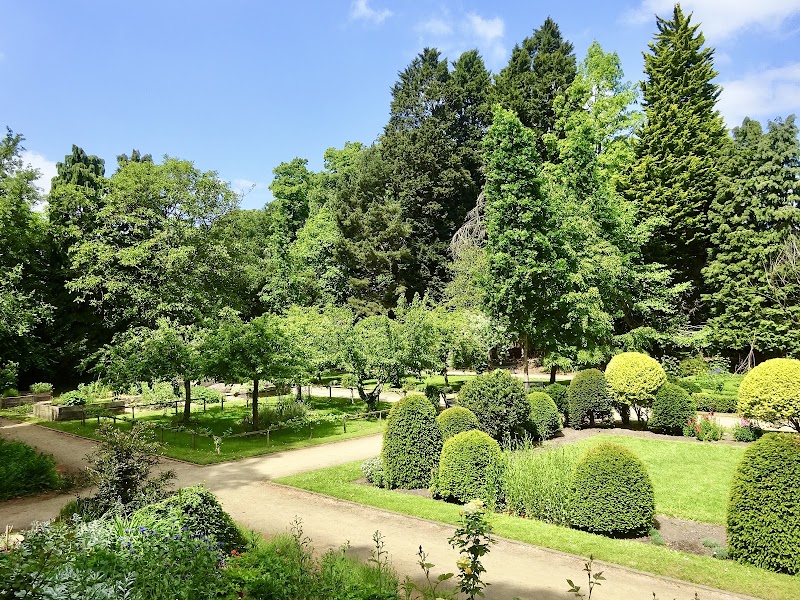
- The Shakespeare Garden — a sunken, walled garden laid out in 1922 and planted only with species named in Shakespeare’s works, one of very few surviving public Shakespeare gardens anywhere.
- The Cathedral Arch — a genuine arch from the nave of Manchester Cathedral, moved first to Manley Hall and then re-erected here in the Ashfield section of the park.
- Platt Fields Market Garden — a working urban farm on a former bowling green, run by Manchester Urban Diggers, producing over a tonne of food a year from about half an acre.
- The Queen Elizabeth II Coronation Fountain — relocated here from Piccadilly Gardens in 2002 and given a second life at the heart of the park.
What you’ll find
At seventy hectares, Platt Fields is not a single space but a patchwork: formal gardens near the hall, open playing fields, a wooded fringe, water at the centre and a busy activity zone along one edge. It is a working neighbourhood park in the fullest sense — students from the nearby university corridor, families from Rusholme and Fallowfield, dog walkers, cyclists and market gardeners all use it at once, and the design absorbs them.
- Gardens — the Shakespeare Garden, a rose garden, a heather garden, a community orchard, an eco garden and a wellbeing-focused TRIM garden.
- Water and wildlife — the lake and its island, which supports nesting waterbirds and gives the park its resident swans, geese and gulls.
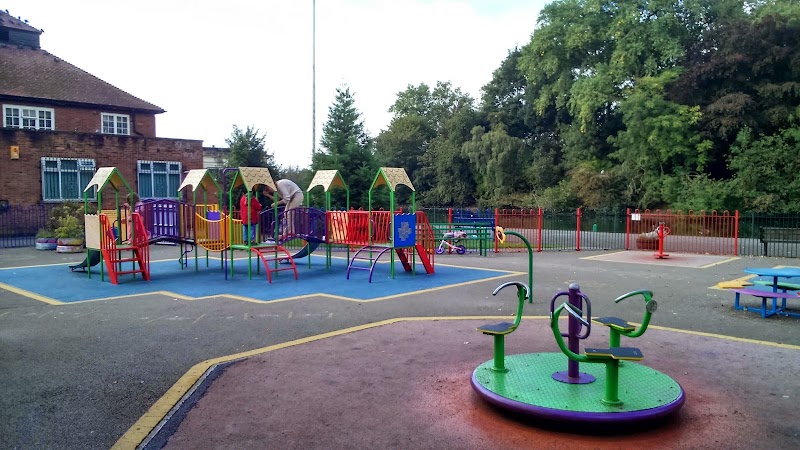
- Play and sport — separate playgrounds for under-fives and older children, a sports zone, tennis courts, bowling greens, hard courts and a BMX track completed in the summer of 2008.
- The Platt Fields Bike Hub — a community cycling project offering repairs, refurbished bikes and training on site.
- Heritage set pieces — the Cathedral Arch, the labyrinth, the coronation fountain and the William Royle Seat, which commemorates the campaigner who made the park possible.
- The Lakeside Centre — the park’s practical hub, with public toilets and a base for events and volunteering.
Things to do — and who it’s for
- Students and young renters — this is the default outdoor room for a dense corridor of shared houses; a lap of the lake and an hour on the grass are the whole point.
- Families — two age-graded playgrounds, wide flat paths for scooters and pushchairs, and enough space for a picnic that does not touch anyone else’s.
- Growers and volunteers — the market garden and the Friends of Platt Fields run regular hands-on sessions, and the produce is genuinely part of the local food chain.
- Garden and history lovers — the Shakespeare Garden is a small, precise, slightly eccentric survival that rewards a slow visit and is almost always quiet.
- Cyclists and BMX riders — the track, the bike hub and the flat perimeter loops make this one of south Manchester’s most useful two-wheel destinations.
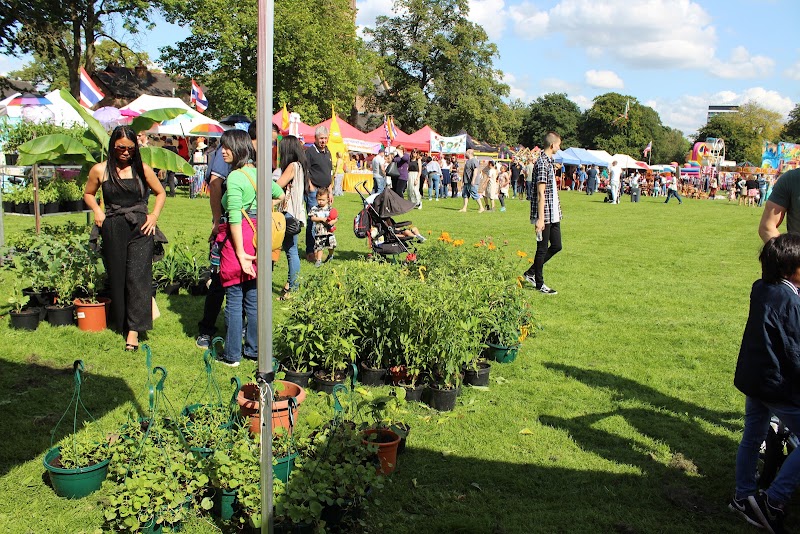
- Festival-goers — the Manchester Mela and Eid celebrations turn the open fields into one of the city’s most vivid public gatherings.
Getting there & practical
The park lies in Fallowfield, right against Rusholme, on the main southern approach into the city centre — one of the busiest bus corridors in Britain, which makes arriving without a car very easy. Routes 42, 142 and 143 all serve the park’s edge and run at high frequency from the city centre, typically taking under twenty minutes. There is no Metrolink stop on the doorstep; the nearest tram stops are Withington and Burton Road on the pink East Didsbury–Rochdale line, close enough to walk or connect by bus. The nearest railway stations are Mauldeth Road and Levenshulme, each a short bus ride or a walk of around twenty minutes. There is on-site parking, but it fills fast at weekends and during events. The park itself is free to enter and open daily; Platt Hall, the market garden and the bike hub keep their own opening hours, which are shorter and seasonal, so check before making a special trip. Half a day covers the park comfortably.
When to visit
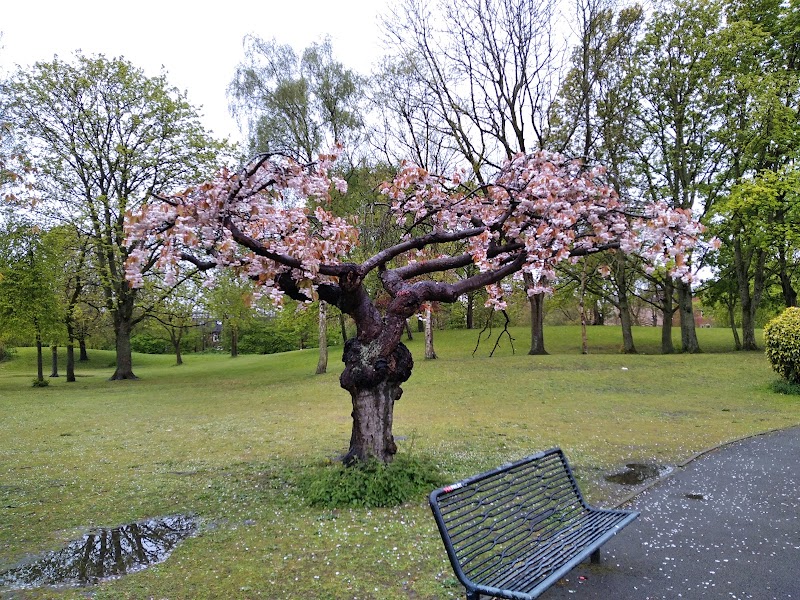
Spring is when the ornamental planting near the hall wakes up and the orchard blossoms, and the lake fills with cygnets and goslings — the best few weeks of the year for a slow walk. Summer is the park at full volume: cricket and football on the fields, the market garden in heavy production, students spread across every south-facing slope, and the big cultural festivals filling the open ground with sound systems, food stalls and dance. Autumn brings the harvest side of the park forward, with fruit coming off the community orchard and the mature trees around the lake turning; it is also the quietest and arguably the most photogenic season here. Winter clears the crowds entirely, the lake often freezes at the edges, and the bonfire and firework display remains one of the fixed points of the local calendar — after which the park settles into a bare, spacious, unexpectedly beautiful few months.
Good to know
The land takes its name from the Platt family, who held the estate from around 1225 for roughly four centuries. The Worsley family acquired it in 1625 and kept it until 1907. When the estate came up for sale, the obvious commercial outcome was housing; a local campaigner, William Royle, mobilised public opinion in favour of municipal purchase, and Manchester Corporation bought the property in 1908 for £59,975 — a very large sum for a city buying open land. The park was then made, rather than merely opened: during the winter of 1908–09, more than 700 men were employed relaying the ground during a period of acute unemployment, creating the lake and island of just over six acres by diverting the Gore Brook. The Lord Mayor, Sir Charles Behrens, formally opened Platt Fields on 7 May 1910. Platt Hall, the Georgian house at the park’s northern end, was built in 1746 at a cost of around £10,000 to designs by Carr of York and modified by Timothy Lightoler; it is listed Grade II*. From 1947 to 2021 it housed the Gallery of Costume, founded on the collection assembled by Cecil Willett Cunnington and spanning dress from the seventeenth century to the present day; that collection has since been transferred to Manchester Art Gallery in the city centre, and the hall has been reimagined as a community cultural venue, with a garden project begun in January 2021 by Platt Hall together with the Friends of Platt Fields and Manchester Urban Diggers. The Ashfield section, formerly the grounds of Ashfield House, was added later and given to the city by Edward Donner; it holds the Shakespeare Garden of 1922 and the arch salvaged from the nave of Manchester Cathedral. Platt Chapel, built in 1699 as the Worsleys’ family chapel, rebuilt in 1790 and modified in 1874–75, served Independent and later Unitarian congregations, ceased to be used for worship in 1970 and has been occupied by local societies since 1977. Much of what earlier generations knew has gone: the twenty-five-yard lido, the model boating lakes, the model railway, Pets Corner and the amphitheatre with its bandstand are all memories, and the old tennis pavilion was demolished in January 2006. What replaced them is arguably closer to the park’s founding spirit — a market garden, a bike hub, volunteer-run gardens and a hall being handed back to the neighbourhood.
Visitor tips
- Walk the Shakespeare Garden first, before the main paths get busy. It is sunken and walled, easy to miss entirely, and it is the one corner of the park where you can hear yourself think on a summer afternoon.
- Check what is on before you come in high summer. Festival weekends are spectacular but the park is packed and parts of it are fenced for the event; a normal Tuesday gives you a completely different place.
- Come by bus. The southern corridor is exceptionally well served and far faster than driving, and the park’s own car park is the first thing to fill on a warm weekend.
Questions & answers
How big is Platt Fields Park? Around 170 acres, or 70 hectares — the largest green space serving central and south Manchester.
Is entry free? Yes, the park is free and open daily. Individual facilities such as the market garden, the bike hub and Platt Hall keep their own, shorter hours.
Can I visit Platt Hall? The hall is Grade II* listed and now operates as a community cultural venue with events, volunteering sessions and guided tours rather than fixed museum opening. The Gallery of Costume that occupied it from 1947 closed in 2021 and its collection moved to Manchester Art Gallery, so do not travel expecting a permanent costume display.
What is the Shakespeare Garden? A sunken, walled garden laid out in 1922 and planted only with species mentioned in Shakespeare’s works — one of the very few public Shakespeare gardens still surviving.
How do I get there on public transport? Frequent buses on the main southern corridor, including routes 42, 142 and 143, stop at the park’s edge and take under twenty minutes from the city centre. The nearest Metrolink stops are Withington and Burton Road on the pink East Didsbury–Rochdale line; the nearest rail stations are Mauldeth Road and Levenshulme.
Is there a boating lake? There is a lake with an island, created in 1908–09, but its role today is as wildlife habitat and scenery rather than as a hire operation. It remains the visual centre of the park.
Is it good for children? Yes — there are separate playgrounds for under-fives and older children, wide flat paths, a BMX track and large open fields, plus the market garden, which runs family-friendly sessions.
What events happen here? The Manchester Mela and Eid celebrations are the biggest, along with the annual bonfire and firework display. The Manchester Flower Show was held here until 2003.
Who was William Royle? The local campaigner who led the push for Manchester Corporation to buy the estate in 1908 rather than let it be developed. A seat in the park commemorates him.
Photos
Show 1 more photos
Visitor reviews
Reviews last updated: 2026-08-04 20:23:00
Data is refreshed monthly. Sources: manchestername.com and editorial picks based on reviews.
Actually, one of my favourite parks.
I go for early morning walks by the pond, there is a cycle path, it is suitable for skateboarders, there are two playgrounds – one for younger children and the other for toddlers.
M…
A place to relax near the Curry Mile in Rusholme. Great for long walks and lazy naps. If you are a keen photographer like me, there are plenty of natural landscapes here to photograph.
Parking around Platt Fields Park is generally free, and depending on the time of day, finding a space around the neighbouring residential streets is usually fairly easy.
The park itself has a really family atmosphere. T…
Platt Fields Park in Fallowfield is a wonderful place to relax among the greenery in Manchester ✨. It is perfect for a quiet walk, a picnic by the lake or simply a break from the noisy student areas nearby. The boatin…
Very disappointed with Platt Fields Park. I lived nearby about 10 years ago. But yesterday I enjoyed it. When I entered the park, I noticed that everything was dry, no flowers, not sure whether it is because of the works…