

19th-century Manchester left a striking impression on visitors. On the one hand, it was the heart of the Industrial Revolution, a prosperous and successful city that earned the nickname “the workshop of the world.”
On the other hand, the city appeared bleak, with soot-blackened buildings and unpleasant black smoke rising in clouds from every chimney. What shocked visitors most was that the thick smog turned the sun into a pale blur in the sky, even on clear days, writes manchestername.com.
The Industrial Revolution That Began in Manchester
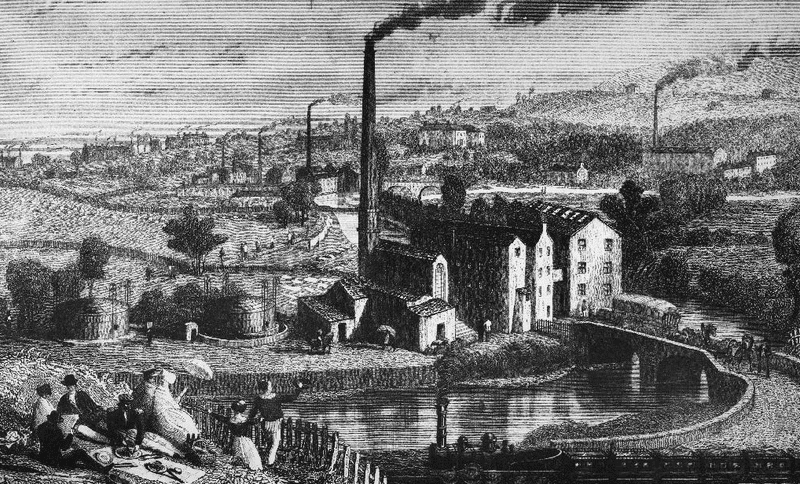
Manchester’s textile manufacturing traditions date back to the 14th century when Flemish weavers settled in the area and began producing wool and linen. By the 16th century, Manchester was a thriving city actively trading wool. Before the Industrial Revolution, all work was done manually.
The advent of the steam engine revolutionized industry, rapidly transitioning production from manual craftsmanship to machine-driven factory operations.
The Industrial Revolution began in Manchester in the late 17th century. Factors such as the humid climate, convenient location, and proximity to Liverpool positioned the city as a pioneer in implementing industrial innovations.
Significant progress in the textile industry was driven by local entrepreneurs, most notably Richard Arkwright. In 1782, he built the world’s first cotton mill in Manchester. Inspired by his success, other entrepreneurs followed suit, installing steam engines in their mills and factories.
By the mid-19th century, Manchester experienced a second industrial revolution, cementing its status as an industrial giant. The city’s population grew as industrial expansion demanded an increasing workforce.
In addition to cotton mills, the city and surrounding areas hosted bleach works, textile printers, foundries, various workshops, and a burgeoning chemical industry.
Smoke as a Symbol of Success and Employment
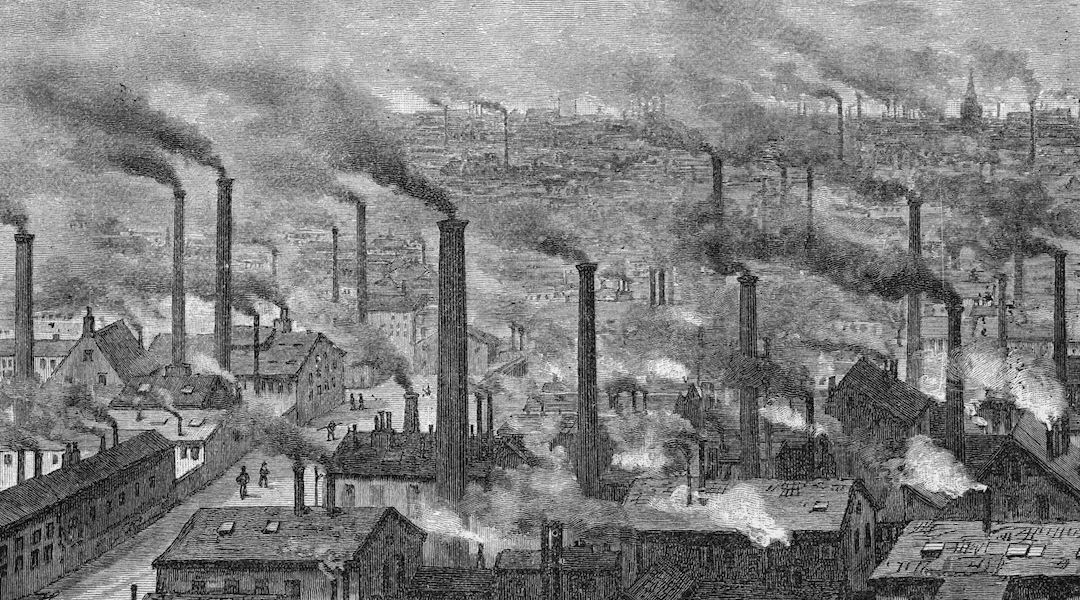
By the 1840s, Manchester had over 500 chimneys, and the number continued to grow. At the time, smoke from coal burning was considered a symbol of industrial prosperity, signifying employment, trade, and economic success.
However, the environmental impact of this pollution was impossible to ignore. Without filters, factory chimneys released all emissions directly into the air that residents breathed.
The primary innovation of the first Industrial Revolution—using coal for thermal energy—gradually replaced charcoal. Coal was sourced from Lancashire mines and was a driving force behind industrial development. However, it severely impacted the environment.
By the late 19th century, Manchester and Salford, part of Greater Manchester, had nearly 2,000 industrial chimneys polluting the air.
Visitors to Manchester during its peak prosperity were often struck by the oppressive atmosphere of smog, soot, and foul odors. The thick smog obscured the sky, making the sun appear as a dim, hazy disc even on sunny days.
French historian Alexis de Tocqueville described Manchester in the 19th century:
“These enormous structures block air and light from entering human dwellings, enveloping them in eternal fog… A black smoke covers the city. The sun, seen through it, appears as a disc without rays.”
Scottish geologist and writer Hugh Miller shared similar observations:
“The first indication of Manchester’s existence is a murky atmosphere hovering over it. A muddy patch in the sky expands and rises as we approach, and then countless chimneys, tall and dim in the gray haze, come into view, each carrying its own banner of darkness.”
Smog’s Impact on Public Health
The polluted environment significantly affected the health of Manchester’s residents. While there were no tools to measure air pollution levels at the time, they were undoubtedly high.
Airborne pollutants from coal combustion caused respiratory diseases and increased rates of heart disease. Mortality rates were notably higher in areas with more coal burning.
Fortunately, some individuals began raising concerns about the environmental and health risks of industrial smoke emissions. Discussions about the harmful effects of black smoke and soot began in the late 18th and early 19th centuries. In 1800, the city’s police commissioners formed a committee to monitor excessive smoke. The committee found that “the increasing number of steam engines and the smoke emitted from chimneys above furnaces, foundries, and bakeries had become a major nuisance.”
By the mid-19th century, anti-smoke societies began to emerge in Britain. In 1842, the Manchester Smoke Abatement Association was established.
Activists encouraged factory owners to burn coal more efficiently and adopt new technologies, such as Lancashire boilers, which reduced black smoke emissions. They also advocated for the use of gas-powered engines, although these were adopted later due to the higher cost of gas compared to locally sourced Lancashire coal.
The activists’ efforts eventually led to the 1956 Clean Air Act, which created “smoke-free zones” in cities like Manchester, marking the first significant improvement in air quality in over a century.
Early Recognition of Long-Term Consequences
By the late 19th century, scientists speculated that carbon dioxide emissions from coal combustion could have long-term global effects, including the greenhouse effect and rising temperatures.
In 1835, mathematician and inventor Charles Babbage warned about the future consequences of unchecked coal combustion:
“The chemical changes thus produced continually increase the quantity of carbon dioxide and other gases in the atmosphere, which are harmful to animal life. The means by which nature decomposes these elements or converts them into solid form remain insufficiently understood.”
Babbage’s concerns were validated years later. A 2016 study published in the prestigious scientific journal Nature suggested that human-induced climate change began as early as the 1830s.
As the world’s first industrial city, Manchester bore the full brunt of air pollution resulting from industrialization—a heavy price for the many benefits brought by the Industrial Revolution.