

When people around the world talk about Manchester, they often picture legendary music bands like “Oasis” and “Joy Division”, or famous football clubs, but certainly not floods. However, in the 21st century, heavy rainfall has become one of the most serious threats to the city. Climate change has intensified storms, made the weather more unpredictable and unstable, turning some areas of Manchester into dangerous zones during the rainy season. For a city where industrial development has historically displaced green spaces, every new week of downpours threatens serious consequences, from flooded streets to infrastructure damage. More at manchestername.com.
Residents are increasingly facing situations where ordinary rain turns into a natural disaster. Old drainage systems cannot cope, and water accumulates near houses, in car parks, and in basements. The city, once famed for its smoky factories and engineering achievements, is now forced to invent new ways of survival—no longer in the economy, but in ecology.
That is why in the 2020s, a genuine ecological revolution took place in West Gorton. The area, which until recently suffered from regular flooding, became the site for one of the UK’s most innovative urban experiments – the “Sponge Park” project. This is not just a park, but a symbol of a new philosophy of urbanism, where nature becomes an ally of technology.
Here, everything is thought out down to the smallest detail: specially selected plants absorb moisture, a water body retains excess water during downpours, and permeable surfaces allow rain to soak into the ground rather than flow into the sewers. Thanks to this, the park literally drinks the rainwater, reducing the risk of flooding and helping to maintain the natural water balance.
A Historical Note
Manchester has long been famous for its rainy weather. Damp, cloudy, and windy—it has shaped the character of the city and its residents for centuries. It was this constant precipitation, seemingly gloomy and grey, that once became one of the factors that made Manchester the industrial capital of Great Britain.
In the days when the city was just beginning to transform into the centre of the textile industry, the humid climate proved to be a real advantage. The moisture-saturated air was ideal for processing cotton: the threads did not dry out or break, which significantly eased the operation of the weaving machines. Thanks to this, it was here, in North West England, that the cotton empire was born, making Manchester a symbol of the industrial era.
But what once contributed to prosperity later became a source of new problems. The rapid industrialisation of the 19th century, the development of factories, population growth, and air pollution disrupted the natural balance. And by the 21st century, the city faced a different reality – global warming had intensified the climatic contrasts.
Now, Manchester’s familiar rains have become not just frequent, but destructive. Downpours unleash with a force that the old stormwater systems were not designed for. As a result, floods are occurring more often, inundating streets and residential areas.
In the 21st century, Manchester is once again forced to adapt, but this time not to economic challenges, but to the challenges of nature. The city is developing ecological and engineering initiatives, such as the “Sponge Park” in West Gorton and other sustainable drainage projects, to protect itself from the consequences of climate change.
From industrial zone to climate innovation
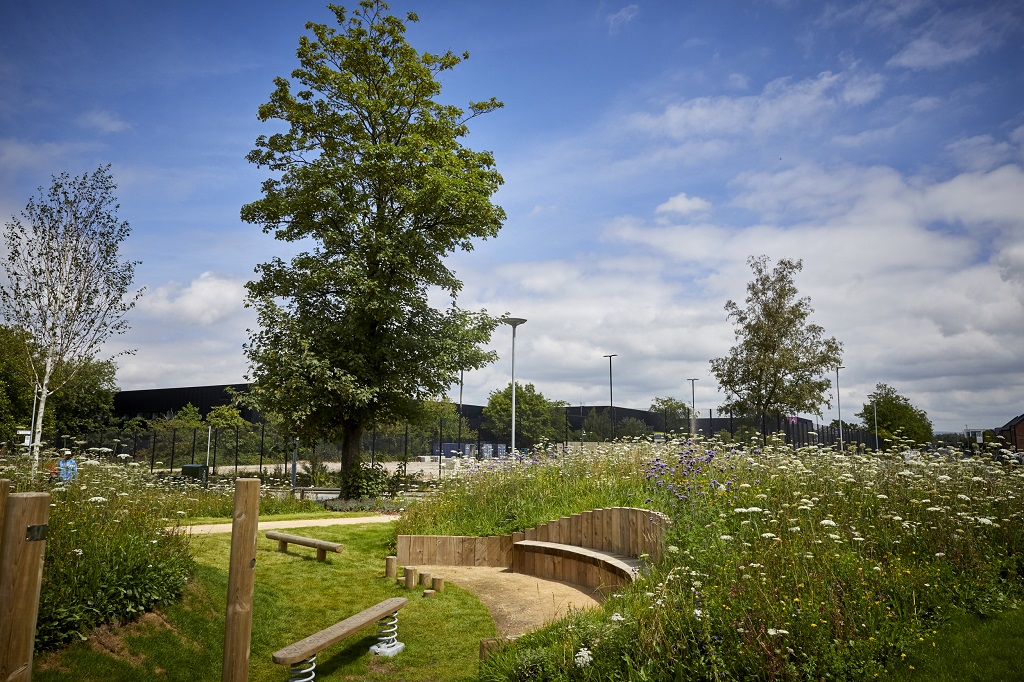
West Gorton, located to the east of Manchester’s centre, has a long industrial history. Decades ago, it was a bustling working-class area with factories and terraced houses. But by the end of the 20th century, the community faced serious decline—unemployment, poor housing, and frequent floods that damaged homes and infrastructure. The ground, hardened by years of construction and pollution, could no longer absorb rainwater.
The situation changed in the 2010s when Manchester City Council, in partnership with the Environment Agency and the University of Manchester, launched a project to transform the area. Instead of building new concrete drainage systems, they carried out a genuine ecological revolution. The idea was simple, yet remarkable: to create a public park that would act like a sponge, absorbing, filtering, and slowly releasing rainwater back into the ground.
The result of this innovation was the “Sponge Park”, which opened in 2020 at a cost of £100 million.
How does the “sponge park” work?
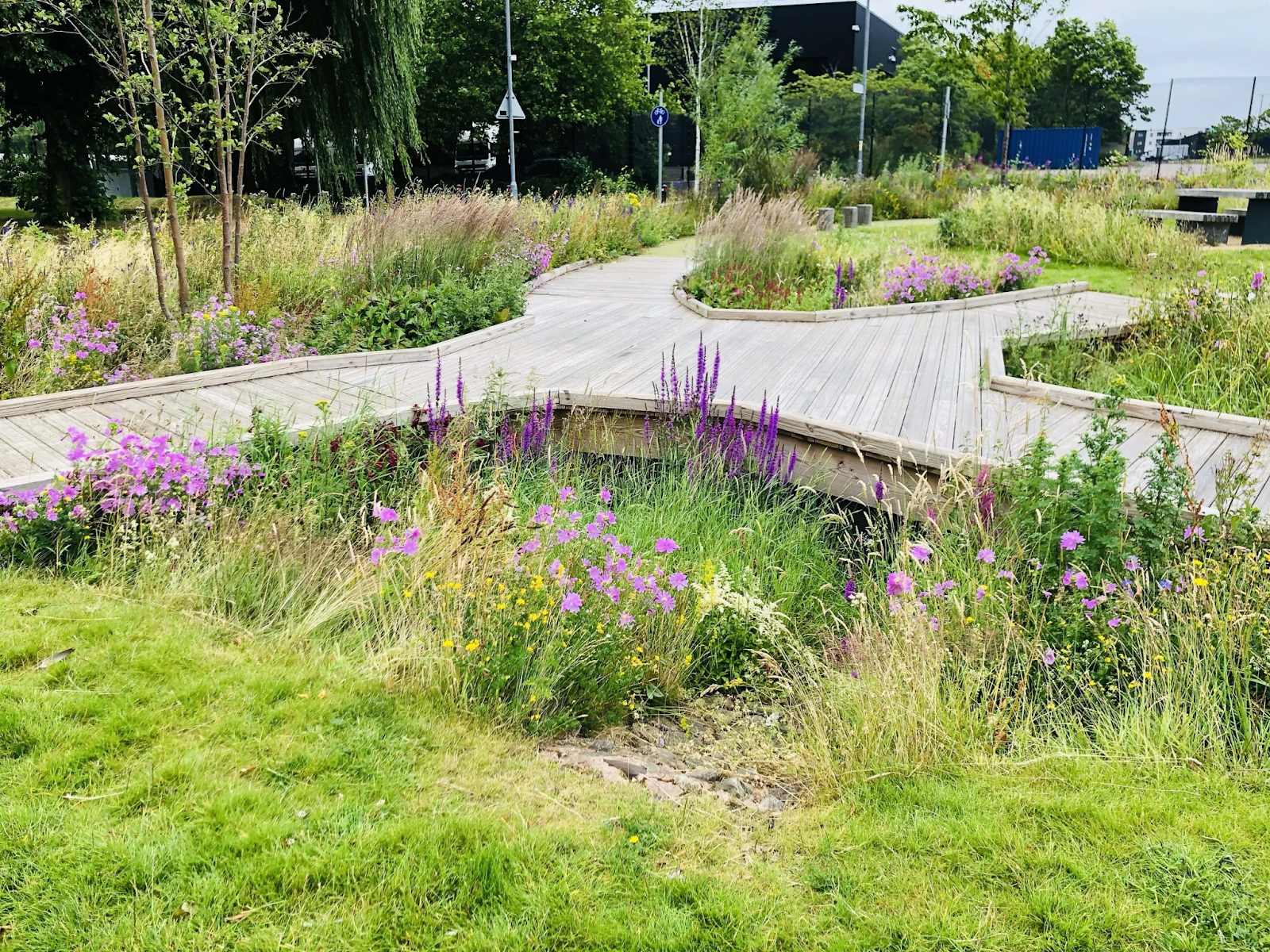
At first glance, “Sponge Park” looks like any other green space—trees, flowers, footpaths, and ponds. But beneath the surface lies a network of thoughtfully engineered solutions that make it a natural flood defence system. The park uses Sustainable Drainage Systems (SuDS)—a combination of soil layers, swales, rain gardens, and retention basins that collect and filter runoff.
When heavy rain falls, the water is not directed into overflowing sewers but instead seeps into the park’s soil and temporary wetlands. Plants and layers of gravel help to clean the water, filtering out pollutants, while underground channels slowly return it to local water bodies. This design can reduce peak floods by up to 50%, protecting nearby homes and streets from damage.
The park doesn’t just manage water resources—it transforms them into beauty. The shallow ponds attract ducks, insects, and wildflowers, creating a true oasis for residents. What was once a grey and flood-prone area has now become a model of ecological sustainability.
A model for a changing climate
In the 2020s, “Sponge Park” has become more than just a local project; it is a blueprint for the future. As Manchester grows, urban planners face the need to find a balance between urban development and environmental protection. In the face of climate change, with its accompanying rains, droughts, and heatwaves, such parks confirm that green infrastructure can be both practical and beautiful.
Its success has inspired similar “sponge city” initiatives across the UK and even Europe. Manchester’s experience has shown that natural solutions—trees, soil, and biodiversity—often outperform traditional concrete infrastructure, drains, and other standard flood control measures. In addition to preventing floods, the park also helps to improve air quality, reduce temperatures, and create habitats for wildlife.
What’s more, local schools and universities use the park as an outdoor classroom, where students study climate change adaptation, ecology, and sustainable design. By integrating education and environmental protection, the project has a long-term social impact, demonstrating to the next generation that cities do not need to fight nature; they can work with it.
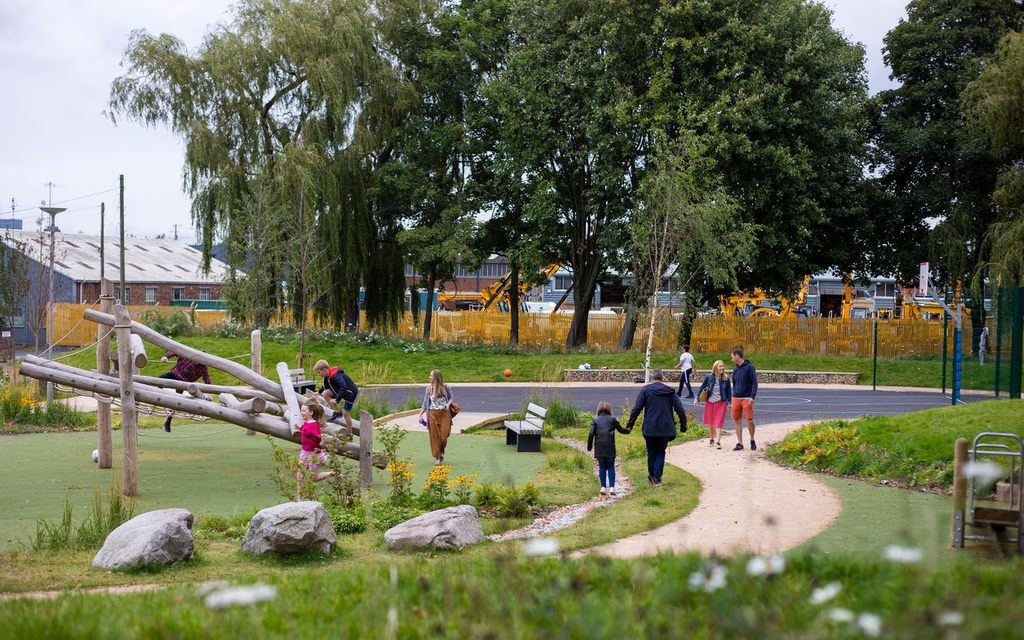
Now, city residents and tourists see the park not only as a defence against floods but also as a symbol of an ecological revolution. A place that once suffered from industrial dereliction is now paving the way for Manchester’s sustainable future. Here, children play on green lawns where old warehouses once stood, and locals stroll along paths that absorb rainwater instead of turning into puddles.
“Sponge Park” has become not just a project, but living proof that cities can change without losing their soul. It has united the community, architects, and scientists around a common goal: to make Manchester liveable, even in the new climatic realities. And, perhaps, it is with such initiatives that a new era begins, where every patch of land works for the well-being of people and the planet.
- https://uk100.gn.apc.org/projects/knowledgehub/manchesters-sponge-park
- https://uk.thegreencities.eu/best_practices/sponge-park-west-gorton-manchester/
- https://projects.research-and-innovation.ec.europa.eu/en/horizon-magazine/sponge-parks-and-vertical-gardens-how-cities-are-using-nature-overcome-extreme-weather