

As early as the 14th century, Manchester began to establish itself as a centre for textile production and trade in linen and wool fabrics. By the mid-18th century, the city became the heart of the Industrial Revolution, solidifying its status as the global centre of the cotton industry, according to manchestername.com.
Although Manchester was primarily focused on the final stages of cotton production and the distribution of finished goods, other industries emerged alongside, including machinery manufacturing, textile equipment production, and the chemical industry. This article delves into the establishment and growth of the latter.
Development of Chemistry as a Science in Manchester
No industry can flourish without scientific expertise. It is the discoveries, innovations, and applications of scientists that drive progress in any field.
Manchester boasts a rich history of prominent chemists whose contributions significantly advanced the chemical sector. Among them was Rona Robinson, the first documented female chemist in Britain and the first woman in the country to earn a degree in chemistry.
Robinson specialised in dye research and later joined William Henry Bentley’s team as an analytical chemist and researcher.
In the latter half of the 19th century, another influential figure in Manchester’s chemical scene was Henry Roscoe. Going further back, in 1803, John Dalton developed the theory of chemical atomism in Manchester. Later, in the 1840s, physicist James Joule laid the foundations of thermodynamics. Organic chemist Edward Frankland also made his mark in 1852 by introducing the concept of valency.
Manchester’s academic institutions played a vital role in this progress, offering education in chemistry and producing well-trained specialists to meet the demands of the chemical industry.
Industrial Dye Production
Although Manchester was not a major centre of chemical production compared to cities in Cheshire, the city excelled in dye manufacturing, a crucial component of the textile industry.
In the 19th century, many chemists dedicated themselves to dye chemistry. For instance, Frederick Crace Calvert focused on the production of coal-tar derivatives. He became an authority on phenol, or carbolic acid, which was essential in the production of synthetic dyes.
Over time, factories and plants dedicated to producing both natural and synthetic dyes began to emerge in Manchester.
The Chemical Business of Ivan Levinstein
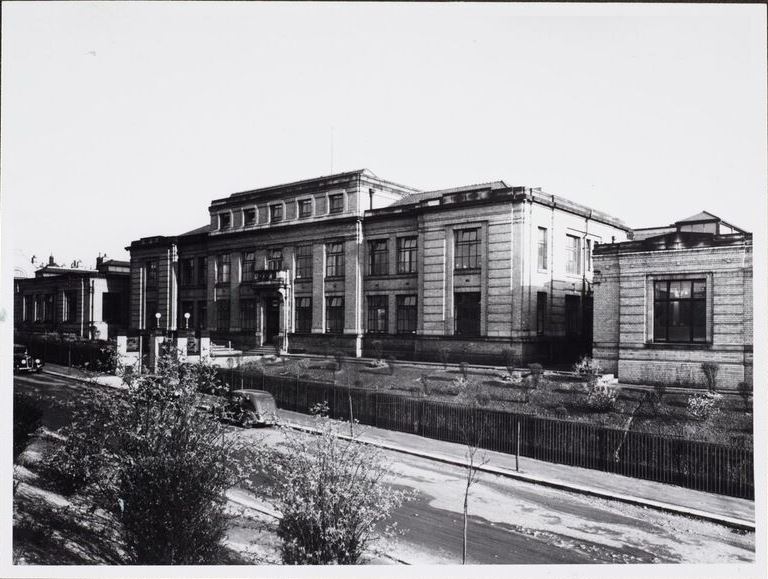
No discussion about the chemical industry in Manchester would be complete without mentioning the contributions of chemist Ivan Levinstein. Born in Germany, Levinstein relocated to Manchester in 1864, where he founded a business specialising in dye production.
Recognising the potential of this industry, Levinstein established his first small factory in Blackley, a district in north Manchester. As his business grew, operations moved to a larger facility in the Manchester suburbs.
Levinstein’s firm became well-regarded in the market, producing notable dyes such as Rosaline (a purple dye), Blackley (blue), and Manchester Brown and Manchester Yellow.
From the 1870s onward, British dyes, including those made in Manchester, began to rival German dyes produced by companies like Bayer and BASF. Concerned about the increasing competition, Levinstein advocated for the imposition of tariffs on imported foreign dyes.
Later, after World War I, the government heeded his warnings. During the interwar years, dye production became a strategic industry in the UK.
Levinstein’s company merged with British Dyes Ltd in 1919 following his death, forming the British Dyestuffs Corporation. By 1926, this corporation became part of Imperial Chemical Industries (ICI).
The Legacy of Imperial Chemical Industries (ICI)
ICI emerged as the largest and most influential British chemical company of the 20th century. In addition to dyes, the company produced pharmaceuticals, plastics, flavourings, and other chemicals. During World War II, ICI played a significant role in the UK’s nuclear weapons programme.