

Power stations are crucial for generating electrical and thermal energy, relying on resources like coal, gas, wind, water, nuclear, and solar power. Carrington Power Station, located near Manchester, stands out as a modern facility that began operation in autumn 2016. As a combined-cycle gas turbine power plant, it powers over one million homes and numerous businesses across Greater Manchester. Known for its exceptional efficiency, Carrington Power Station is also equipped to transition to renewable energy sources such as wind and solar, making it a key player in the region’s move toward sustainability. Next on manchestername.com.
Built on the Grounds of a Former Coal Power Station
The state-of-the-art Carrington Power Station was constructed on the site of a former coal-fired power station situated along the southern bank of the Manchester Ship Canal in Greater Manchester.
In 1916, Manchester City Council acquired this location with plans to build a coal power station as a backup for the Barton facility. However, these plans were delayed for decades.
After World War II, the site was revisited. In 1947, Manchester City Council’s Department of Electricity initiated designs for the Carrington coal power station, and construction began later that year.
The coal station officially opened in 1956, although its first generator was operational as early as 1953. It featured four turbo-generators, each with a capacity of 60 MW, resulting in a total output of 240 MW.
During the mid-1980s, the station hit record electricity production levels, meeting peak demands during winter evenings. However, it was decommissioned in the late 1980s, and in 1991, the station was demolished using explosives.
The Transition to a Gas Power Station
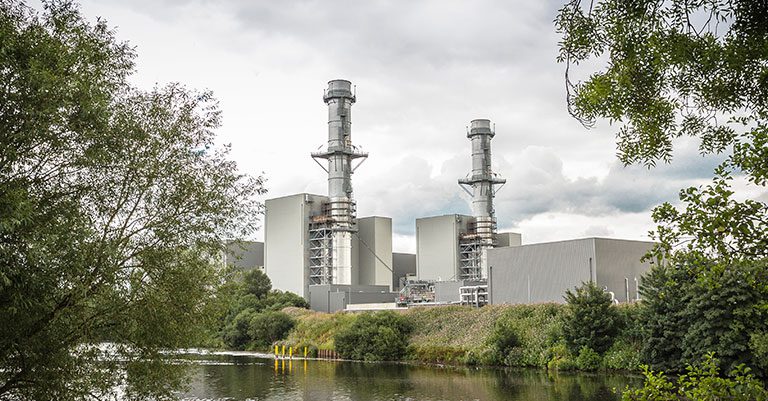
By the early 2000s, the site between Carrington and Partington remained unused. In 2007, planning permission was granted for a new combined-cycle gas power station.
Construction of the new 880 MW gas-fired power station began in 2013 at an estimated cost of £1 billion. The project was spearheaded by Carrington Power, a subsidiary of the Irish energy company ESB Group.
Equipment for the station was sourced from several countries, including China, Indonesia, Germany, Poland, and Spain. Components were transported by sea to Ellesmere Port in Cheshire and then delivered to Carrington via the Manchester Ship Canal. ESB Group noted that this method of transportation helped avoid the release of approximately 200 tonnes of carbon dioxide.
The station was officially commissioned in autumn 2016. In addition to generating electricity, the facility provided steam for industrial use, making it a combined heat and power (CHP) plant.
The construction of Carrington Power Station created over 800 jobs. Workers were transported to and from the site using double-decker buses, an initiative aimed at reducing traffic and its impact on the local community.
Carrington Power Station is recognized as one of the most efficient gas-fired plants in the UK. It supplies power to more than one million homes and numerous businesses across Greater Manchester.
What sets this power station apart is its ability to integrate renewable energy sources such as wind and solar, reflecting its commitment to sustainability and energy transition. This capability ensures Carrington Power Station remains a vital part of the UK’s energy landscape, balancing efficiency with environmental responsibility.