

Long-term research into the problems of global warming has revealed that modern metropolises and cities (especially buildings) are one of the main sources of environmental pollution. After all, the residents of buildings consume electricity, primary energy and drinking water all over the world. As a result of these studies, ecological construction, which is also called green construction, appeared at the turn of the 20th and 21st centuries. As manchestername.com notes, this method means designing and constructing buildings in the most ecological way and with care for the environment.
The Green Building is a vivid example of green construction in Manchester. This ecological building is aimed at minimising the negative impact on the environment. In this article, we will tell you more about it.
History
The Green Building appeared in Manchester in the early 2000s. The housing complex was built at 19 New Wakefield Street. This area was once one of the darkest and most run-down in the city. It was also known as Little Ireland. In past centuries, there were mills, factories and workers’ houses around them. Most of those people were extremely poor.
Over time, this area was reconstructed. Most of the buildings that appeared here were intended for residential purposes.
One of them was ecological and multifunctional The Green Building. The Farrells company headed by the famous architect and its founder, Terry Farrell, was engaged in the design of this building. The entire process of building an ecological residential building was undertaken by one of the largest construction companies in Great Britain, Taylor Woodrow.
The ecological building is comfortably located near public transport stations, including one of Manchester’s most popular train stations, Oxford Road. You can get to many cities of the country from that station. Metrolink tram stops are also located next to the eco-friendly residential complex.
Thus, the location of the house actually forces its residents to abandon personal vehicles that consume fuel and, accordingly, pollute the environment. Moreover, there are no parking spaces near the house and no underground parking.
However, there are outside and inside places for storage of bicycles.
Features of The Green House
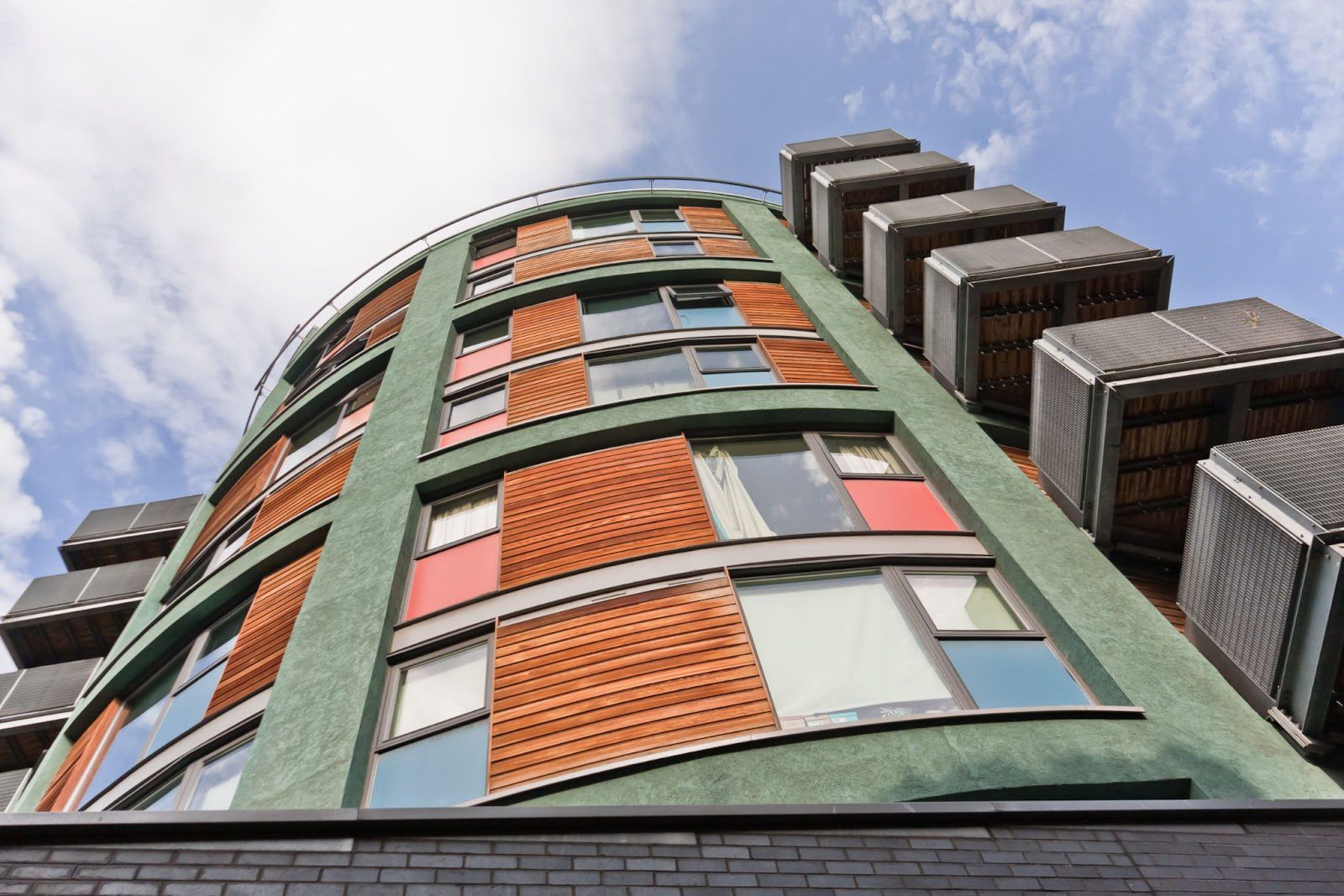
The Green House is an eight-story cylindrical building. It embodies the architectural concepts of low energy consumption. The slanted roof of The Green Building attracts special attention. It faces south to get the most out of the sun’s energy.
The reinforced concrete structure of The Green House performs the role of a temperature regulator. The house also has an atrium. It is an open space inside the building that resembles a courtyard. It also performs the role of natural ventilation. The glass ceiling of the atrium provides natural lighting to the main circulation areas, which also helps reduce energy use.
The south windows of the house are bigger than the north ones. Thus, more solar energy can be obtained from the southern side.
The house also had a solar thermal water heating system for some time. However, later, it was suspended and the consumers switched to gas boilers.
Each apartment has only shower rooms and no bathtubs because using a shower instead of a bath reduces water consumption. In addition, the residents should choose appliances that minimise the consumption of water and electricity. The bathrooms and lobbies have low-voltage lighting with a power of 50 W.
The combination of modern architectural design and innovative engineering solutions resulted in an ecological building with low energy consumption.
In 2006, Farrells’s architects won the Sustainable Civic Trust Award for The Green Building in Manchester.